|
| Accueil |
Créer un blog |
Accès membres |
Tous les blogs |
Meetic 3 jours gratuit |
Meetic Affinity 3 jours gratuit |
Rainbow's Lips |
Badoo |
[ science ] [ Newspaper ] [ culture ] [ Biography ] [ Movie ] [ chicken soup for the ] [ Fashion ] [ Fashion ] [ online shopping ]
|
|
|
|
Anatomy of a pianist
08/01/2010 07:31
THE young woman is sitting on the bench in front of a piano playing Chopin under the glare of stage lights and cameras. She's playing what she has likely practised for hours on end. But her 24-year-old teacher, a world-renowned pianist says she just can't seem to get it right.
"Da dada da dada," the teacher sings before reaching over the piano to show the young woman how to do it properly. His eyes are hidden behind strands of his hair. His ears are tuned to the echoes of Chopin. His fingers dance on the keys.
He is Li Yundi who will have a concert in Beijing on December 3. Born in Chongqing in 1982, Li went to the Sichuan Conservatory of Music in 1994. Li went on to take the top prize at the International Chopin Competition in Warsaw, Poland in 2000. He was the youngest first-prize winner in the contest's history.
Li has just graduated from the Hanover Conservatory of Music, Germany after five years study.
In a recent exclusive interview with Li in a Beijing pub, I was able to examine his body from head to toe as I wondered how a pianist makes all his body parts produce this magic.
Here's the anatomy of a pianist:
Eyes & mind
Though Li's interpretation of Liszt and Chopin may take listeners to dreaming places, Li insists he cannot free his mind to go with them. "I can't [go places] because I must concentrate on the logical side. I need to understand what I am doing. But, also, I need to be in the box — or space. First, I need to control it. And, second, I need to find the balance, how I can be relaxed to go somewhere by feeling. I cannot go outside the box."
Ears
Among the sounds that inspire Li are car engines (especially really powerful ones), waves on the shore, the quiet of an early morning, and vocal music.
Oh, yes, classical pianists can enjoy a good hip hop beat too.
But for Li, music is best listened to on a CD player. "I have an iPod, but I never use it. I like to take every CD with me. I feel it is a kind of art. I don't want to see it only as a computer piece."
Mouth
"I like vocal music — especially opera," Li says. "I think an opera singer can give me a lot of ideas because of the melody, and because of how they breathe. Singing is the part of music that can touch people directly. An instrument has difficulty getting to that level. But that is the best way for a pianist to play."
Hands
Although Li says that he's never taken out an insurance policy on his hands, he admits to avoiding "dangerous sports" like basketball. After all, "Everything comes from my hands. The music is from my hands. The money of course is from my hands. Everybody knows me from my hands."
A broken finger, no doubt, would mean a big challenge.
| |
|
|
|
|
|
|
|
New York towers rise again
07/01/2010 11:05
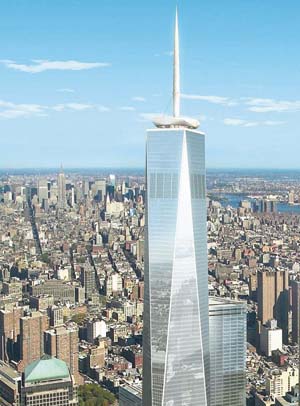
FIVE years have passed since New Yorkers saw the twin towers of the World Trade Centre, and many lives, destroyed by terrorists. However, four new buildings will soon rise again on the site, bigger and better than before.
Famous Polish architect Daniel Libeskind, and American David Childs were chosen by the public in 2003 to lead the project.
They will work on the site's tallest building, the Freedom Tower, and several memorials to the victims of September 11.
The tower will be 1776 feet (541.3 metres) high. "It represents the Declaration of Independence," said Libeskind, referring to the year in which the US won independence from Britain.
Work was started in April this year. The skyscraper should be completed by 2008 and ready to use by 2011.
A museum on the ground floor will make sure those who died on September 11, 2001 are never forgotten.
Three other skyscrapers will be built on the site. Normal Foster, Richard Rogers and Fumihiko Maki have each contributed a design. However, the buildings will be smaller than the Freedom Tower.
The site will be developed by businessman Larry Silverstein who will work together with New York's Port Authority (which controls the area). They will pay for the rebuilding costs. They want to fill the hole in the heart of the city with interesting buildings. And, they hope to make New Yorkers feel proud "in honour of the memories of the heroes we lost".
| |
|
|
|
|
|
|
|
The world's tallest building will open on Monday
05/01/2010 05:40
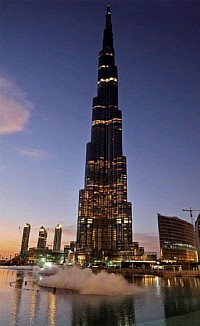
Started at the height of the economic boom and built by some 12,000 labourers, the world's tallest building will open on Monday in Dubai
Full coverage: Dubai debt crisis
as the glitzy emirate seeks to rekindle optimism after its financial crisis.
Burj Dubai, whose opening has been delayed twice since construction began in 2004, will mark another milestone for the deeply indebted emirate with a penchant for seeking new records.
Dubai, one of seven members of the United Arab Emirates, gained a reputation for excess with the creation of man-made islands shaped like palms and an indoor ski slope in the desert.
With investor confidence in Dubai badly bruised by the emirate's announcement in November that it would seek a debt standstill for one of its largest conglomerates, the Burj Dubai is seen as a positive start to the year after a bleak 2009.
The project has been scrutinised by human rights groups, who have objected to its treatment of labourers, as well as by environmentalists who said the tower would act as a power vacuum, increasing the city's already massive carbon footprint.
But despite the criticism, many say the edifice, believed to have cost $1.5 billion to build, is an architectural marvel.
The tower's height has been kept a closely guarded secret until now. Developer Emaar Properties PJSC will reveal the height -- known to exceed 800 metres (2,625 feet) -- on Tuesday and Dubai's ruler will inaugurate the opening.
Experts believe Dubai's recent financial troubles have not hurt sales of approximately 1,100 residential units in the Burj -- meaning tower in Arabic -- saying they were nearly all sold.
Dubai's real estate sector crashed at the end of 2008 when the global financial crisis hit the emirate after a six-year economic boom. Thousands of jobs were slashed and projects worth billions of dollars were cancelled or delayed.
With analysts suggesting tax-free Dubai might sell some of its assets to boost revenues and slash $80 billion in debt, many wondered if the tower was on the list for grabs.
Dubai, with few natural resources of its own, expects a budget deficit of 2 percent of GDP this year.
In December, the emirate received a $10 billion lifeline from neighbouring Abu Dhabi to repay a $4.1 billion bond for Nakheel, a property arm of indebted Dubai World, and other obligations.
| |
|
|
|
|